

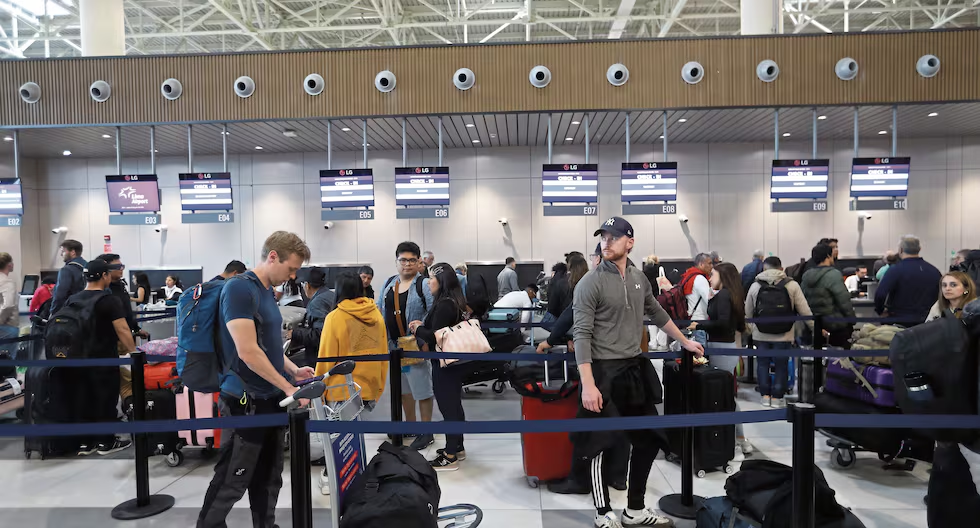
(Picture: Reproduction)
Growth Crisis: latin american airports face collapse with overcrowding and logistic bottlenecks
From chaotic ground access to endless immigration queues, the region’s infrastructure fails to keep pace with demand explosion, turning the passenger experience into a test of patience.
The airline sector in Latin America is living a paradox: commercial success has become its greatest operational challenge. Several terminals in the region are recording passenger volumes that drastically exceed projections for the decade. Luis Muñoz Marín Airport in Puerto Rico is a clear example: it closed 2024 with 13.2 million travelers—a mark that, according to Aerostar Airport Holdings, was only expected by 2043. This demand anticipation of nearly 20 years forced the implementation of emergency solutions.
In Bogota, El Dorado confirmed its status as the continent’s busiest hub, surpassing 45 million passengers in 2024, a 16% growth. Although praised for efficiency—with 90% of users passing security in less than 10 minutes—the absolute volume pressures the terminal’s physical limits.
The nightmare of ground access
For many travelers, the problem isn’t flying, but getting to the airport. Ground access has consolidated itself as the region’s main bottleneck. In Lima, Peru, the new international airport faces a logistical mismatch: designed for the future, its access depends on a viaduct that will only be ready in 2028, making the route through Callao unpredictable.
The situation repeats in El Salvador, where a single access road generates chronic congestion. In Costa Rica, the General Cañas highway turns the trip to Juan Santamaría airport into an odyssey of over an hour during peak traffic. In Brazil, Guarulhos Airport (SP) still suffers from a lack of direct rail connectivity, relying on shuttle buses and awaiting a people mover promised for over a decade. In Argentina, the Riccheri highway, a vital route to Ezeiza, is frequently blocked by protests, adding a layer of risk to travel planning.
Internal efficiency vs. operational chaos
Inside the terminals, the experience is uneven. While Carrasco Airport (Montevideo) shines with 93% efficiency in controls thanks to technology, other hubs fight against the clock. In Santiago, Chile, immigration lines can last an hour. In San Juan, the wait at TSA reaches 45 minutes.
Beyond time, service quality is a target for criticism. Mexico City Airport (AICM) faces signage issues and staffing shortages. In Guarulhos and Lima, complaints focus on cleanliness and abusive food prices. Lima also deals with the controversy of the Unified Airport Use Fee (TUUA), which generates friction with airlines. Extreme cases, such as power outages in Venezuela and radar failures in Costa Rica, expose the systemic fragility of certain operations.
The future: growth vs. infrastructure
Despite the obstacles, projections continue to rise. Lima expects 25.8 million passengers in 2025, and expansion plans are underway from Buenos Aires to Bogota. However, the conclusion is clear: the challenge for Latin American aviation is no longer just about aircraft and routes. For the sector to reach its potential, ground infrastructure, security processes, and basic services need to evolve at the same speed as ticket sales.
Resumo em Português:
O transporte aéreo na América Latina enfrenta uma crise de crescimento, com aeroportos como os de Porto Rico e Bogotá superando projeções de passageiros décadas antes do previsto. O artigo destaca que os principais gargalos não estão no ar, mas no solo: o acesso terrestre é caótico em países como Peru, Brasil e Costa Rica. Além disso, falhas internas, filas na imigração e preços elevados comprometem a experiência do viajante, evidenciando um descompasso entre a demanda explosiva e a infraestrutura defasada.
Resumen en Español:
El transporte aéreo en América Latina enfrenta una crisis de crecimiento, con aeropuertos como los de Puerto Rico y Bogotá superando las proyecciones de pasajeros décadas antes de lo previsto. El artículo destaca que los principales cuellos de botella no están en el aire, sino en tierra: el acceso terrestre es caótico en países como Perú, Brasil y Costa Rica. Además, fallas internas, filas en migración y precios elevados comprometen la experiencia del viajero, evidenciando un desajuste entre la demanda explosiva y la infraestructura obsoleta.


